The uncomfortable truth about Meta advertising in 2026 is that most campaigns do not fail at launch – they fail right after early success.
The first results often create a false sense of confidence. During the initial 10-14 days, performance can look promising: cost per lead feels efficient, click-through rates are strong, and the client starts to believe the system is already working at scale. This is exactly the moment when many businesses make a strategic mistake – they assume the campaign has “stabilized,” while in reality Meta is only beginning to understand where the strongest conversion signals live.
Why Meta Ads Stop Working After 30 Days
What happens next is familiar to almost every brand that has tried to scale aggressively. Frequency starts to rise, the same creatives become predictable, lead quality begins to fluctuate, and the algorithm gradually expands into lower-intent audience pockets. The CPL increases, but more importantly, the business loses confidence in the channel itself, often blaming Meta instead of the architecture behind the campaign.
At Axe Digital Group, we rarely see Meta fail because of targeting alone. The real issue is usually structural.
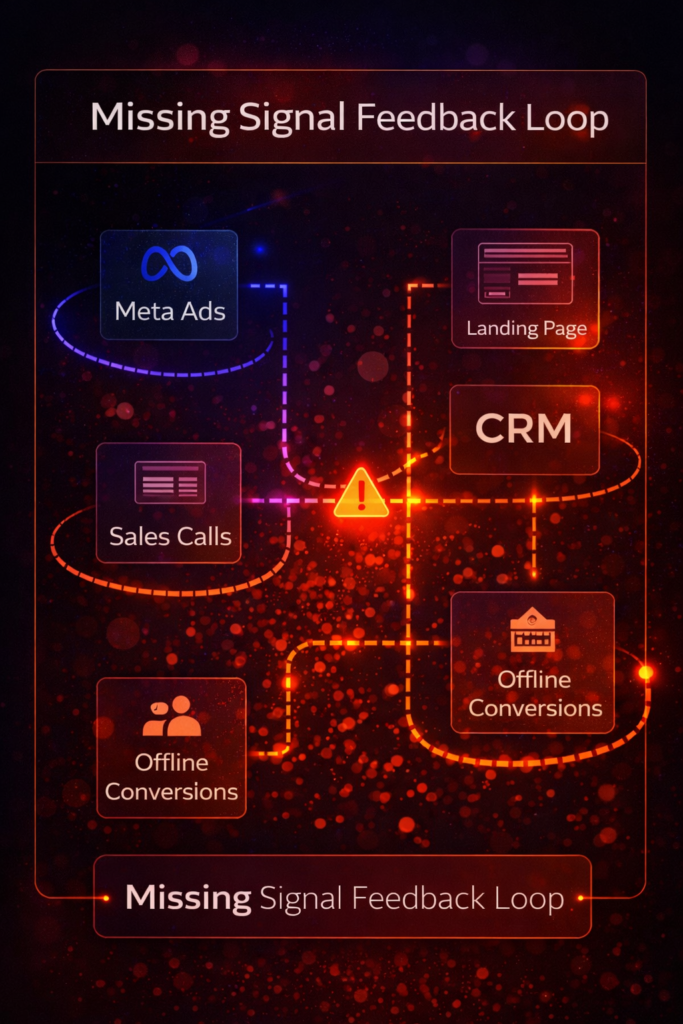
Most underperforming accounts share the same hidden weaknesses: the creative strategy is treated as a one-time production task, lead feedback never returns into the ad system, and campaigns optimize around cheap form fills rather than qualified sales conversations. From the outside the dashboard may still look “healthy,” but underneath, the machine is already slowing down.
The brands that continue scaling past the first month operate very differently.
They treat Meta as a living performance ecosystem, not a static ad launch.
The Real Cause of Creative Fatigue
This starts with creative velocity. In today’s auction, the first three seconds of a video, the opening emotional hook, the format-native storytelling, and the speed of creative iteration matter far more than minor targeting tweaks. A winning campaign is rarely built on one strong ad. It is built on a creative testing engine that continuously introduces new objections, fresh angles, new audience psychology triggers, social proof layers, and vertical-specific pain points.
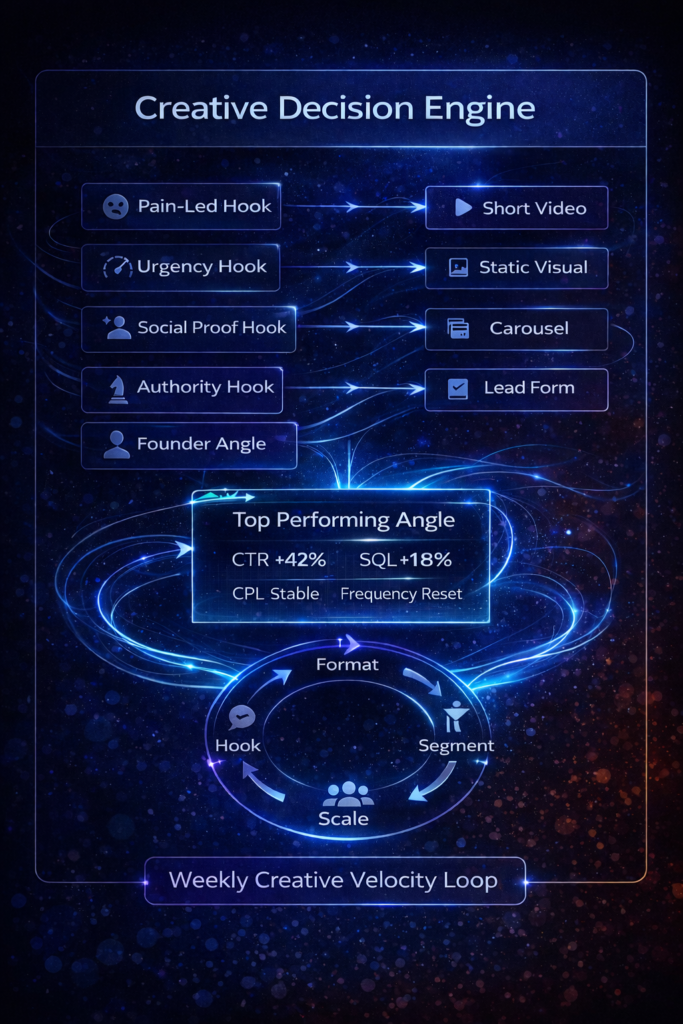
The difference between average advertisers and high-performance brands is not the number of creatives, but the speed and structure of creative decision-making. A scalable Meta Ads system continuously tests new hooks, formats, audience segments, and landing pathways, allowing the algorithm to find new conversion pockets before fatigue impacts performance.
Why CRM Feedback Loops Matter for Meta Scaling
For example, a legal services client and a restaurant group may both run lead generation campaigns, but the emotional architecture behind conversion is completely different. One converts through urgency, trust, and perceived expertise. The other converts through atmosphere, desire, and timing. Treating both with the same “book a consultation” logic is exactly why many agencies plateau early.
The second layer is signal quality.
Meta’s AI-driven delivery is only as intelligent as the data infrastructure behind it. If the platform is trained on low-quality leads, it will scale low-quality behavior. This is why modern campaign systems must connect ad performance with downstream outcomes: call duration, CRM qualification stages, booked meetings, reservation confirmations, or revenue-linked offline conversions.
Without this feedback loop, scaling becomes guesswork.
With it, Meta begins optimizing toward business outcomes rather than vanity efficiency.
How High-Performance Brands Build Creative Velocity
This is where high-performance brands separate themselves from average advertisers. They do not ask whether the CPL is €8 or €12 in isolation. They ask which creative angle generated the consultation that closed into a €15,000 service agreement, which geography produces higher lifetime value, and where retargeting compresses decision time.
That level of visibility changes how budget decisions are made.
Instead of “turning spend down because CPL went up,” the brand can confidently increase investment where revenue probability is strongest.
For businesses in local services, property sales, legal, hospitality, and high-ticket B2B, this approach transforms Meta from a traffic channel into a predictable demand generation system.
And that is the real difference between campaigns that burn out after 30 days and campaigns that continue compounding.
The platform itself is rarely the problem.
The growth ceiling is almost always created by the system behind it.
The Meta Ads Scaling Framework Used by Axe Digital Group
4-step framework
- Creative velocity engine
- CRM signal loop
- Offline conversion sync
- Revenue probability scaling
For brands that want Meta to become a serious revenue channel, the question is no longer whether ads are running. The question is whether the business has built the creative, data, and feedback architecture required for scale.
Scale Meta Ads Beyond the First 30 Days
At Axe Digital Group, we build Meta Ads systems that combine creative velocity, CRM feedback loops, and revenue-focused scaling frameworks for local services, legal, hospitality, and high-ticket brands.